Poria Incrassata: Infestation
Poria Incrassate is a wood-decaying fungus belonging to a group of fungi referred to as the “brown rot family,” which differs from the other members of this family by its unique characteristic that it provides its own moisture. Although it is rare, it is often mistaken for mold or rot. The difference is it attacks a home’s wood framing members, causing instability problems for your home’s structure, ultimately increasing the liability risk for injury or collapse occurring.
The main destructive feature of this fungus is that it is its own moisture source. The excess water that may be found in the soil beneath and surrounding your home’s foundation may be the start of significant structural damage and the inevitable decay and collapse of your home’s support beams, exterior wall framing, wood siding, roof framing system, decks or patio covers if Poria is present. Poria can travel at any given depth in search of moisture in the soil. Therefore, Poria cannot be removed from the soil it infects.
 Because Poria brings its own water source, the initial damage noticed may appear to be similar to water damage such as on a wood floor that begins to buckle or cup and eventually caves in. The second stage of Poria eating the wood support members materials beneath the wood flooring materials may look similar to wood rot as the wood product is broken down to a white chalk or dust-like consistency as it eats floor joists, wood framing members and the wood flooring material. Once it eats the wood materials, there is no evidence or remnants of the wood materials that were once there as they appear to have vanished. What appears to be the collapse or caving in of the flooring is actually the result of the support beams or sub-floor’s complete disappearance due to the Poria.
According to Southern California Poria Incrassate Specialist, J. Luis De La Cruz from Wood Preservation Services, you cannot successfully test to confirm Poria Incrassate. Testing for Poria requires obtaining “live” samples of decay fungi from the infected wood. Removal of a piece of wood infected by Poria for testing in a lab or to take a sample from the site and place it in a petri dish disconnects it from its moisture source, which is the one thing that sustains its life. This also allows other more prominent bacteria from the air to show up in the test results rather than the Poria as it is no longer living. Testing will only conclude that Poria is from the “brown-rot family” of fungi, however, there are hundreds of strands that fall under this category. Therefore, incurring costs for lab testing fees (these can range from $900 - $1,500.00) to confirm the presence of Poria is pointless. The important thing is to ensure that there are no wood members that come in contact with the soil and that there is enough space separating the home’s wood framing or siding from the soil.
Poria is commonly mistaken to be the result of a water intrusion issue. If not recognized in a timely manner, Poria will continue to cause damage to the home’s structure unbeknownst to the homeowner until a collapse occurs after the wood support or framing members are completely eaten away.
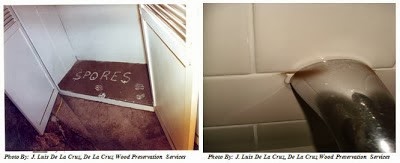
 Once Poria is established, it continues to be active in the soil year-round and produces reproductive fruiting bodies twice a year (mainly in May and November). During its reproductive stage, Poria can transport moisture into the colonized area from an astonishing 150-foot distance, which makes it impossible to locate its original source. The consumption of wood then increases and millions of spores are produced. Because Poria secretes its own enzyme onto the wood, the wood eventually turns to mush. The affected wood components become saturated, exceeding the wood’s capacity to retain water. The excess water can be found pooling within the infected area, causing water damage to the building materials. The spores are a dark reddish brown film and are expelled with tremendous pressure, making them airborne, covering the flat surfaces around the infected area. As long as the supply of water is available for the Poria, the water-conducting fungi can colonize and decay the wood of the entire structure. The bad news about Poria is that it’s hidden and it spreads fast. The good news is, once you find it, it’s growth can be controlled and ultimately stopped completely once proper construction design is put in place.
 Homeowners beware: Poria Incrassate can cost you tens of thousands of dollars in repairs if it is not recognized timely. Given that Poria is considered a mold or fungus, many insurance policies exclude or limit coverage for removal of building materials damaged by Poria and any repairs needed to replace the affected materials. If Poria is not correctly identified in the initial investigation stage of the claim, your homeowner insurance company may exclude coverage entirely due to Poria’s resemblance to rot, which generally is not covered by insurance due to it being a long-term issue.
The Solution: add concrete footings or a concrete stem wall around your home’s foundation to prevent the Poria from coming in contact with wood posts and framing members and make sure there is at least a 4-inch gap between the soil and the base of any wood siding or wood materials. Once the infected wood is removed, the Poria strain dies as it no longer has access to its source of moisture in the soil. However, if the construction design is not changed that allowed the Poria to come in contact with wood materials of the home and the Poria still has a moisture source, it will attack the new wood materials that replaced the previous infected ones that were removed.
Make sure to get a qualified professional on the job from the time you first notice damage and before you start a remodel project on your home. Call Specialized Outsource Solutions for referrals of reputable contractors and experts who follow the proper guidelines for design and re-construction of your home, including plumbing, water restoration, mold remediation, testing for mold, inspections for Poria incrassata and building repairs. SOS’ can refer specialists, experts and contractors that are just a phone call away to help you protect your investment - 1-888-589-1868 or request referrals for reputable experts and contractors from our website.
>> Find a professional's interpretation of this blog post HERE "From the Expert"Make sure to get a qualified professional on the job from the time you first notice damage and before you start a remodel project on your home. Call Specialized Outsource Solutions for referrals of reputable contractors and experts who follow the proper guidelines for design and re-construction of your home, including plumbing, water restoration, mold remediation, testing for mold, inspections for Poria incrassata and building repairs. SOS’ can refer specialists, experts and contractors that are just a phone call away to help you protect your investment - 1-888-589-1868 or request referrals for reputable experts and contractors from our website.
Poria Incrassate is a wood-decaying fungus belonging to a group of fungi referred to as the “brown rot family,” which differs from the other members of this family by its unique characteristic that it provides its own moisture. Although it is rare, it is often mistaken for mold or rot. The difference is it attacks a home’s wood framing members, causing instability problems for your home’s structure, ultimately increasing the liability risk for injury or collapse occurring.
The main destructive feature of this fungus is that it is its own moisture source. The excess water that may be found in the soil beneath and surrounding your home’s foundation may be the start of significant structural damage and the inevitable decay and collapse of your home’s support beams, exterior wall framing, wood siding, roof framing system, decks or patio covers if Poria is present. Poria can travel at any given depth in search of moisture in the soil. Therefore, Poria cannot be removed from the soil it infects.
 Because Poria brings its own water source, the initial damage noticed may appear to be similar to water damage such as on a wood floor that begins to buckle or cup and eventually caves in. The second stage of Poria eating the wood support members materials beneath the wood flooring materials may look similar to wood rot as the wood product is broken down to a white chalk or dust-like consistency as it eats floor joists, wood framing members and the wood flooring material. Once it eats the wood materials, there is no evidence or remnants of the wood materials that were once there as they appear to have vanished. What appears to be the collapse or caving in of the flooring is actually the result of the support beams or sub-floor’s complete disappearance due to the Poria.
According to Southern California Poria Incrassate Specialist, J. Luis De La Cruz from Wood Preservation Services, you cannot successfully test to confirm Poria Incrassate. Testing for Poria requires obtaining “live” samples of decay fungi from the infected wood. Removal of a piece of wood infected by Poria for testing in a lab or to take a sample from the site and place it in a petri dish disconnects it from its moisture source, which is the one thing that sustains its life. This also allows other more prominent bacteria from the air to show up in the test results rather than the Poria as it is no longer living. Testing will only conclude that Poria is from the “brown-rot family” of fungi, however, there are hundreds of strands that fall under this category. Therefore, incurring costs for lab testing fees (these can range from $900 - $1,500.00) to confirm the presence of Poria is pointless. The important thing is to ensure that there are no wood members that come in contact with the soil and that there is enough space separating the home’s wood framing or siding from the soil.
Vigorous poria growth can result in water damage:
Poria is commonly mistaken to be the result of a water intrusion issue. If not recognized in a timely manner, Poria will continue to cause damage to the home’s structure unbeknownst to the homeowner until a collapse occurs after the wood support or framing members are completely eaten away.


The Solution: add concrete footings or a concrete stem wall around your home’s foundation to prevent the Poria from coming in contact with wood posts and framing members and make sure there is at least a 4-inch gap between the soil and the base of any wood siding or wood materials. Once the infected wood is removed, the Poria strain dies as it no longer has access to its source of moisture in the soil. However, if the construction design is not changed that allowed the Poria to come in contact with wood materials of the home and the Poria still has a moisture source, it will attack the new wood materials that replaced the previous infected ones that were removed.
Make sure to get a qualified professional on the job from the time you first notice damage and before you start a remodel project on your home. Call Specialized Outsource Solutions for referrals of reputable contractors and experts who follow the proper guidelines for design and re-construction of your home, including plumbing, water restoration, mold remediation, testing for mold, inspections for Poria incrassata and building repairs. SOS’ can refer specialists, experts and contractors that are just a phone call away to help you protect your investment - 1-888-589-1868 or request referrals for reputable experts and contractors from our website.
>> Find a professional's interpretation of this blog post HERE "From the Expert"Make sure to get a qualified professional on the job from the time you first notice damage and before you start a remodel project on your home. Call Specialized Outsource Solutions for referrals of reputable contractors and experts who follow the proper guidelines for design and re-construction of your home, including plumbing, water restoration, mold remediation, testing for mold, inspections for Poria incrassata and building repairs. SOS’ can refer specialists, experts and contractors that are just a phone call away to help you protect your investment - 1-888-589-1868 or request referrals for reputable experts and contractors from our website.